Daytime attic noise usually means squirrels
Squirrel Removal in Orlando, FL
Squirrels are rodents and they do the same damage, but they work during daylight while rats work at night. That single difference is the fastest way to know what you are dealing with.
When a homeowner calls and says the noise in the attic happens in the morning and again in the late afternoon, the species question is usually already answered. Squirrels are diurnal. Rats and mice are nocturnal. If you are hearing activity while you are having breakfast, you are almost certainly dealing with squirrels rather than roof rats, and that changes both the approach and the timing of the work.
Squirrels are also considerably larger and stronger than a roof rat, which shows in the openings they make. Where a rat exploits an existing gap, a squirrel will readily create one by chewing through a gable vent screen, a fascia board, or a soffit panel. The openings tend to be rounder, larger, and much more visible from the ground, which at least makes the inspection more straightforward.
The other complication is timing. Squirrels have young in the nest for part of the year, and removing an adult while dependent young remain in an attic creates a problem that is both inhumane and expensive, since the young die inside the structure. A competent inspection checks for this before anything is sealed, and it is one of the reasons squirrel work is not simply rat work with a bigger trap.
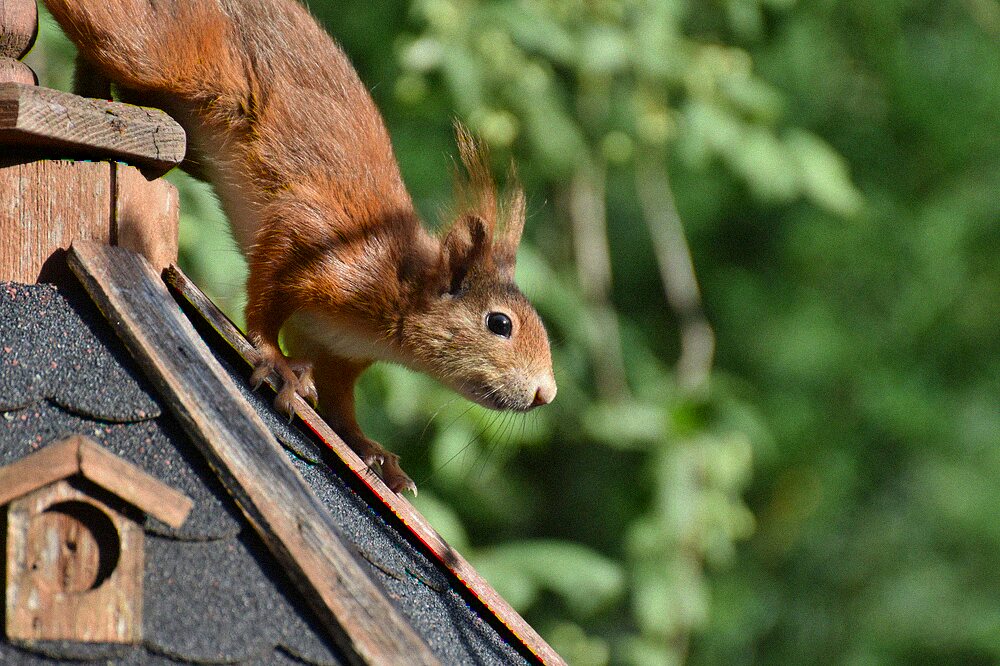
How to know it is squirrels
Time of day is the primary indicator, and it is reliable. Squirrels are active shortly after dawn and again in the late afternoon, with quiet periods in between. Rats start at dusk and peak in the small hours. If you are hearing scampering overhead at seven in the morning, that is a squirrel.
The sound is heavier and faster than a rat, with more scampering and rolling and less of the light scratching people associate with rodents in a ceiling. Homeowners often describe it as sounding like something considerably bigger than it turns out to be, because a squirrel moving quickly across a ceiling joist makes a lot of noise.
Outside, look at the roofline for a round opening roughly the size of a fist, typically at a gable vent, along the fascia, or where the soffit meets the roof. Chewed and splintered wood around the opening, rather than a clean gap, is characteristic. You may also simply see the animal using the entrance, since squirrels are not secretive about their route.
The damage squirrels do
Squirrel incisors grow continuously and squirrels chew more aggressively than rats. In an attic that means electrical wiring, which is the damage worth taking seriously, along with flexible ductwork, plumbing lines, roof decking and stored belongings. Chewed wiring in an attic is a genuine hazard and a reason not to leave an active squirrel problem running through a season.
Structurally, the entry point itself is often the more expensive item. A squirrel that has chewed through a fascia board or destroyed a gable vent has created an opening that needs carpentry rather than mesh, and repairing it properly is part of the exclusion work rather than an optional extra.
Nesting material accumulates faster than with rats because squirrels build substantial nests from insulation, leaves and anything else available. That means more contamination, more compressed insulation, and more R-value lost in an attic that needs to perform through a Central Florida summer.
Why timing matters more with squirrels
Squirrels raise young in nests, and Florida populations breed across an extended season. If dependent young are present in an attic, sealing the entry point after removing the adult leaves them to die inside the structure. That produces an odor problem, a secondary insect problem, and a repair bill for opening up a ceiling to retrieve them.
The inspection therefore checks for young before any sealing happens, and the sequencing adapts to what it finds. Where young are present, the approach waits until they are mobile enough to leave with the adult, or removes them together, depending on circumstances.
This is the part of squirrel work that separates a considered job from a quick one, and it is worth asking any company you are quoting whether they check for young before sealing. It is a short question and the answer tells you how carefully a job is being planned.
How a Squirrel Job Is Done
Similar structure to rat work, with an added check for young and more carpentry in the exclusion phase.
- 1
Inspection
The roofline, gable vents, fascia and soffit are checked for the entry opening, and the attic is inspected for nesting sites and for dependent young before anything is sealed.
- 2
Removal
One way doors and trapping on the active opening, allowing the animals out without allowing them back in, timed around whether young are present.
- 3
Repair the opening
Squirrel entry points usually need carpentry rather than mesh alone. Fascia boards, soffit panels and gable vent frames get repaired and then screened in steel.
- 4
Seal the secondary openings
The rest of the roofline is closed so the next animal does not simply select a different weak point.
- 5
Cleanup and restoration
Nesting material removed, the space sanitized, chewed wiring flagged for an electrician, and contaminated insulation replaced where needed.
What This Costs in Orlando
Squirrel jobs frequently cost more than a comparable rat job, for one reason that is easy to miss. The animal usually made its own opening, so the exclusion phase includes carpentry rather than only mesh and sealant.
| Service | Typical range | What moves the number |
|---|---|---|
| Inspection | Free with service | Standalone reports run 0 to 175 dollars |
| Squirrel removal | $300 to $1,200 | Number of animals, whether young are present, difficulty of roof access |
| Entry repair and exclusion | $500 to $2,500 | Carpentry for chewed fascia, soffit or gable vent, plus sealing the rest of the roofline |
| Attic cleanup and decontamination | $600 to $2,500 | Nest volume, contamination level, attic size |
| Insulation replacement | $2.50 to $5.50 per sq ft | Squirrel nests displace and compress a large area of insulation |
These are typical ranges for the greater Orlando metro. Every property is different, and the free inspection produces the actual figure with each part of the job priced as its own line item.
Why Homeowners Choose Us for This Work
We check for young before sealing anything
Sealing an attic with dependent young inside creates an odor and repair problem far worse than the original job. The inspection checks first and the sequencing adapts around what it finds.
The opening gets repaired at the timber
A squirrel usually chewed its way in, so the entry point is damaged timber rather than an existing gap. Screening over rotted or splintered fascia fails. Repairing it and then screening in steel is what holds.
Experienced, state-registered technicians
The technicians who come to your property are registered with the State of Florida, carry their own insurance, and represent more than 30 years of combined pest control experience. Someone answers this line 24 hours a day.
What Reddit Says About Squirrel Removal in Orlando
Squirrel threads in public forums are dominated by price disagreement more than technique. A recurring pattern is a homeowner posting a quote in the low thousands for squirrel removal plus roof repair and asking whether it is reasonable, followed by a genuine split in the responses. Some commenters with trade experience argue such figures are far above what the work should cost, while others point out that ladder work at height, multiple return visits for trap monitoring, and roof material costs add up quickly and defend the same number as fair.
What both sides agree on is more useful than the disagreement. Nobody argues that trapping alone is sufficient. The advice that appears in every one of these threads is to make sure the entry point is properly repaired, because a squirrel that chewed through a fascia board once will find the same weakness again, and because the opening is usually structural damage rather than a gap. Commenters also consistently advise pricing the work out yourself, including traps, removal and roof materials, as a sanity check on any quote.
The vetting advice is the same as elsewhere in this trade and it is worth repeating. Get multiple bids for identical scope, insist that the quote separates removal from repair from cleanup, and ask specifically what happens if the animals return. On squirrel work, add one more question that matters here more than anywhere else: ask whether they check for young before sealing the entry point.
What a Typical Job Looks Like
A typical project on a two story home with a chewed gable vent
The situation. Scampering overhead starting around seven each morning and again before dusk, plus a homeowner who noticed daylight visible through the gable vent from inside the attic. The vent screen had been chewed through and the surrounding trim was splintered.
What gets done. The inspection confirms a single adult and no dependent young, so a one way door goes on the gable opening and the rest of the roofline is checked and closed. Once the animal is out, the damaged trim is repaired and the vent is rebuilt and screened in steel rather than the original plastic mesh. Nesting material is removed and the insulation in the affected area is replaced.
How it turns out. The morning noise stops and the attic is closed at the point that failed. Because the repair addressed the timber rather than covering it, the weak spot that let the first animal in is genuinely gone rather than screened over.
Common Questions
How do I know if it is squirrels or rats in my attic?
Time of day answers it in most cases. Squirrels are active in daylight, particularly early morning and late afternoon. Rats and mice are active after dark. Squirrel entry openings are also larger, rounder and more visible from the ground, usually with chewed and splintered wood around them.
Can squirrels damage wiring?
Yes, and it is the damage most worth taking seriously. Squirrel incisors grow continuously and they chew more aggressively than rats. Chewed wiring in an attic is a real hazard, and where we find it we flag it for an electrician rather than treating it as within scope.
What happens if there are baby squirrels in the attic?
The inspection checks for this before anything is sealed, because sealing the entry with dependent young inside leaves them to die in the structure. Where young are present, the removal is timed or handled so the family leaves together.
Why is a squirrel job sometimes more expensive than a rat job?
Because the animal usually made its own opening. A rat exploits an existing gap that can be closed with mesh and sealant. A squirrel has often chewed through a fascia board or destroyed a gable vent, so the exclusion phase includes carpentry.
Will they come back after they are removed?
Not through the same opening if it has been repaired and screened in steel. Squirrels do return to structures they have used before, so the rest of the roofline gets closed at the same time to stop the next animal simply selecting a different weak point.
Do I need the attic cleaned after squirrels?
Usually yes, and more often than after rats. Squirrels build substantial nests from insulation and debris, so there is more material to remove and more insulation displaced and compressed than a comparable rat infestation leaves behind.
Related Services
Rodent Inspection
A full roofline, attic and foundation inspection that tells you what is actually happening.
Read more →Rodent Exclusion
Sealing every entry point so the problem ends instead of repeating.
Read more →Attic Cleanup & Decontamination
Droppings, nesting material and contamination removed and the space sanitized.
Read more →More about how we work on the about page, or get in touch to book a free inspection.
Get the Opening Repaired Properly
A free inspection confirms the species, checks for young before anything is sealed, and prices the removal, the carpentry and the cleanup as separate items.